

.jpg)



.jpg)


.jpg)


-webp.webp)
-webp.webp)


-webp.webp)


-Özetini-Yayınladı-webp.webp)


-webp.webp)

-webp.webp)

-webp.webp)
-webp.webp)


-webp.webp)
-webp.webp)
-webp.webp)
-webp.webp)
-webp.webp)
-webp.webp)
-webp.webp)
-webp.webp)
-webp.webp)
-webp.webp)
-webp.webp)

-webp.webp)


-webp.webp)


-webp.webp)
-webp.webp)

-webp.webp)


-webp.webp)
-webp.webp)


-webp.webp)
-webp.webp)


-webp.webp)


-webp.webp)
-webp.webp)


-webp.webp)
-webp.webp)


-webp.webp)


-webp.webp)

-webp.webp)


-webp.webp)
-webp.webp)

-webp.webp)


-webp.webp)


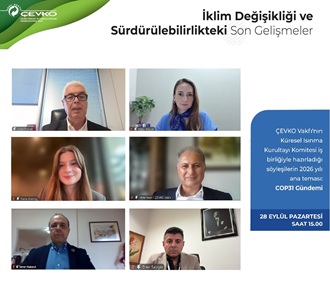
ÇEVKO Foundation Climate Change and Sustainability Working Group, in cooperation with the Global Warming Council Committee, held the third session of the 2023 ÇEVKO Foundation Interviews, which addressed the climate crisis from all aspects, under the title "Recent Developments in Climate Change, Green Deal and Sustainability". The online interview was moderated by Celal Toprak, Chairman of the Global Warming Council Committee, and ÇEVKO Foundation Secretary General Mete İmer hosted the session. The speakers of the interview were CarrefourSA OHS, Environment, Quality Assurance and Sustainability Group Manager Tayfun Akusta, Niğde Ömer Halis Demir University Department of Environmental Engineering Waste Management Coordinator Assoc. Prof. Dr. Ece Ümmü Deveci and Niğde Ömer Halis Demir University Climate Ambassador Ahmet Fatih Akansu.
ÇEVKO Foundation Secretary General Mete İmer: “We are Pleased That the Action Plan Has Reached the Preparation Phase”
Chairman of the Global Warming Council Committee and Moderator Celal Toprak emphasized the great importance of including universities in these interviews and thanked ÇEVKO Foundation Secretary General Mete İmer for his sensitivity on this matter, leaving the floor to him. Starting his speech by saying, “Our academics and our students are really important stakeholders. This year, we are organizing these events together with both our industrial organizations and our universities”, Mete İmer continued as follows: “I would like to share information about a few important developments. There are three important legislative regulations that reached us in August. Two of these are action plan preparations and the other is a draft climate law. Having a climate law, placing a cost and limit on carbon is quite important in combating the climate crisis. The action plans prepared probably with the contributions of various stakeholders by the Ministry of Environment, Urbanization and Climate Change of the Republic of Turkey contain detailed information such as the target year, outputs and performance indicators, responsible institution, and relevant institutions for each action under a specific title. The sub-titles of the climate change action plan related to waste, which will reduce greenhouse gas emissions, are as follows: Prevention and reduction of solid waste and wastewater before formation, increasing recycling and recovery rates of waste, reducing the rate of waste sent to landfills without pre-processing, improving waste water management and treatment infrastructure, increasing social awareness within the scope of zero waste practices and greenhouse gas emission reduction, developing incentive and financing mechanisms to improve waste management considering circular economy principles and greenhouse gas emission reduction, increasing R&D activities related to this and developing technological infrastructure, increasing the use of waste as a resource/raw material in production, and reducing greenhouse gas emissions from vehicles used in waste management.”
ÇEVKO Foundation Secretary General Mete İmer underlined that as the ÇEVKO Foundation, they are pleased to see that the climate change action plan related to waste, aimed at reducing greenhouse gas emissions, is in the preparation phase: “We had been saying that when the circular economy action plan in the European Union is followed by legislative regulations, we also have to comply with this and put forward our own action plans. Now, we are pleased to see that the preparation phase has been reached. The point we have always emphasized here is that waste is a resource, a raw material; the importance of recycling and increasing recycling, and raising the targets in accordance with this. The financing mechanism we have advocated from the beginning especially in waste management, with the Extended Producer Responsibility (EPR) model, is also considered among financing mechanisms. There is also a draft circular economy action plan prepared similarly. Of course, after these plans are finalized, what matters is to put the actions into practice and implementation; and ensuring that the actions actually achieve results when the determined targets and dates come. This is a very comprehensive task and it would be unfair to expect success in this matter solely from a ministry or state institutions. Therefore, as all stakeholders including industrial organizations, NGOs, universities, individuals, we all need to support this process. In the fight against climate crisis, it is now necessary to switch to a holistic, completely different economic model. First, we must recognize this, share what it means with all parties, and work together.”
CarrefourSA OHS, Environment, Quality Assurance and Sustainability Group Manager Tayfun Akusta: “Our Motto; The Right Thing for Life”
CarrefourSA OHS, Environment, Quality Assurance and Sustainability Group Manager Tayfun Akusta started his speech by sharing current information from Turkey and the world and continued with the following important statements: “As CarrefourSA, we gathered all our sustainability activities under a single motto: ‘The Right Thing for Life’. For our employees, stakeholders, customers and our planet, in short, we work with the goal of doing what is right for life. We identified what we will do under the umbrella of sustainability for each of these, and carried out its communication. Within the scope of CDP (Carbon Disclosure Project), we are the only food retail company in Turkey reporting in the ‘Deforestation’ module which was scored for the first time. In this module, which we reported for the first time, we received a B score, achieving an important success. In addition, we succeeded in entering the ‘Global A List’ in the ‘Water’ module, where only 103 companies worldwide are included. This shows the transparency and sincerity of our work. We continue our activities in line with Sabancı Holding’s (Carbon Net Zero) target. We will publish our 2022 Sustainability Report soon. Since last September, we have been working to eliminate food waste, and since the beginning of the project, we have saved more than 400 tons of food from becoming waste. With our project ‘Don't Be Deceived by Appearance, Give Its Taste a Chance’ we carried out a project to enable both the sale and different evaluations of products approaching their expiration date. “Shop with Your Own Container”, CarrefourSA Bizim Bahçe, Nature Friendly Plate (a project that also received awards including from ÇEVKO) are among our other important projects. In addition, we collect waste vegetable oils together with our customers in our stores and ensure their recycling, and we donate the income obtained to Tohum Autism Foundation. In the same way, we turn the income obtained from the recycling of used batteries into books for children through AÇEV’s A Future That Reads campaign. In 2022, we launched 17 sustainable products with a 26% increase. We aim to increase these products by at least 5% compared to the previous year.”
Niğde Ömer Halis Demir University Department of Environmental Engineering Waste Management Coordinator Assoc. Prof. Dr. Ece Ümmü Deveci: “We Also Sign Projects That Touch the Public at Our University”
Assoc. Prof. Dr. Ece Ümmü Deveci said: “We carry out studies that touch society and students” and shared information about their work: “With the establishment of the Zero Waste system in 2018, we put our sustainability studies into action. We continue by thinking about how we can take one more step further. Our Rector Prof. Dr. Hasan Uslu, like our previous Rector Prof. Dr. Muhsin Kar, provides great support to our work. When face-to-face education started again after the pandemic, we did not stop, we continued. We never stopped, from ‘Bring Your Cup, Take Your Tea’ practice to seed ball project. We set out with the philosophy of acting together with our youth. We have new plans. This year, there was also the earthquake. In regions affected by the earthquake, we saw that single-use products were used more and efforts to reduce waste decreased. I think single-use products should be reduced and removed from our lives. To manage waste at its source, it is not enough to only do studies at universities, as a society we also have responsibilities. Once we give this motivation to the student, we need to support them to continue at home. Currently, there are 11.2 million tons of solid waste in the world. The source of this much waste is only humans! Then the ones to manage this will also be humans. Therefore, in order to ensure sustainability of life, transfer resources to future generations, and leave a livable world, we need to look at our resources from a different perspective, from water usage to electricity usage. Humans are responsible for the majority of solid waste. Therefore, people need to make different changes in their lifestyles. I support second-hand usage of municipalities, and the sale of second-hand products on some internet sites. Zero Waste also means reducing at the source. Less shopping, reducing single-use products, reducing the amount of waste is of great importance. We are also making the second tender of the waste we collect at the university, we are excited because we are bringing it into circular economy. We want to generate less waste and collect less, and reduce energy and water consumption to reduce Carbon Footprint. Now, we need to use Artificial Intelligence in waste collection activities to make waste more efficiently manageable. I think municipalities should move towards systems that will use both human resources and energy resources more efficiently. People cannot separate waste at its source properly, and when they collect recyclable waste they ask me what to do. They say “I bring it to the waste bin at the university but I cannot do this at home”. Then what is the purpose of all this effort? We have scientific data for proper waste management, but unfortunately it stays in files or libraries. Now it is time to put this information into practice. For this reason, academia, society and industry must act together.”
Niğde Ömer Halis Demir University Climate Ambassador Ahmet Fatih Akansu: “18 Different Types of Waste Are Controlled at Source at Our University”
Fatih Akansu explained the climate-friendly Green Campus and Zero Waste practices of Niğde Ömer Halis Demir University with examples: “Our university is one of the 11 pilot universities within the scope of the Sustainable and Climate Friendly Campus Protocol jointly signed by YÖK and the Ministry of Environment, Urbanization and Climate Change. In December, we received the Zero Waste Best Practice Award for our work. At our university, 18 different types of waste, from plastic waste to medical waste, are controlled at the source. There are 2,900 waste bins in 483 points in 32 buildings. We use six-compartment collection equipment. In our sustainability work, we consider 5 basic principles: Principle of Concrete to Abstract, Principle of Easy to Difficult, Principle According to Person, Principle of Vitality, Learning by Doing. Every individual within our university receives training. Peer trainings according to faculties also continue. We organized a Zero Waste walk within the campus. An outdoor waste bin design competition was held. We have a Zero Waste Club, the Climate and Ecology Society was established, of which I am the president and founder. As a awareness activity, Waste Audit Practice was carried out. We published amateur waste videos shot by students, and when these videos were published, it led to a desire to shoot more videos, and suddenly we started to grow. Paper production from waste papers obtained from the waste collection center was also carried out by students of the art education department. The Zero Waste Workshop was held with the participation of many climate ambassadors and hundreds of students from other universities. Two waste paper containers and 8 collection cages for plastic bottles are available in the downtown campus. We also collect the waste we collect at the waste collection center located in our main campus. Together with our municipality, we carried out activities during the Environment Week. With the contribution of our Rector, we organized a bicycle festival, seed ball throwing event, and tree planting activities are carried out regularly. We organized webinars with UN diplomats under the name Let’s Talk About Climate Change, and we will continue. We will establish a Zero Waste Garden. The garden will operate in line with zero waste. We will offer filter coffee and tea and there will be absolutely no waste. There will also be a deposit machine inside the zero waste garden. Our university was also selected as a Specialized University in Hydrogen and Fuel Cell Technologies. We also have a Green Energy House, we give electricity produced from solar panels and hydrogen energy both to the grid and use it for the units where students charge their phones.”
ÇEVKO Foundation Secretary General Mete İmer concluded the event by thanking the participants: “We mentioned the concept of circular economy for the first time in 2017 as a result of our contacts in Europe. Now, we are pleased to see that this concept has also been adopted in our country. In fact, Zero Waste is a result of circular economy. I was very pleased to convey the exemplary practices of Niğde Ömer Halisdemir University from central Anatolia, both in Zero Waste and in combating the climate crisis. We will continue to raise awareness to reduce waste, and to collect and recycle recyclable waste separately at the source in an integrated manner using digital methods, which is a persistent problem in our country.”
The third interview titled "Recent Developments in Climate Change, Green Deal and Sustainability" prepared by the ÇEVKO Foundation Climate Change and Sustainability Working Group, in cooperation with the Global Warming Council Committee, can also be watched on the YouTube channel of the ÇEVKO Foundation:


Information Notice and Personal Data Protection Policy under the Personal Data Protection Law: The personal data listed by way of example in Article 2 of the Personal Data Protection Policy may be shared with the ÇEVKO Foundation and used on its website, applications, and social media channels, to be used in notifications and recommendations, and to be shared with third parties for commercial purposes provided that it is in the interest of the members, and I hereby accept and declare my explicit consent, defined under the KVKK as “consent based on information and freely given for a specific purpose.”
You can manage cookie categories separately
For more information, you can check the Privacy Policy and Protection of Personal Data pages