

.jpg)




.jpg)


.jpg)


-webp.webp)
-webp.webp)


-webp.webp)


-Özetini-Yayınladı-webp.webp)


-webp.webp)

-webp.webp)

-webp.webp)
-webp.webp)


-webp.webp)
-webp.webp)
-webp.webp)
-webp.webp)
-webp.webp)
-webp.webp)
-webp.webp)
-webp.webp)
-webp.webp)
-webp.webp)
-webp.webp)

-webp.webp)


-webp.webp)


-webp.webp)
-webp.webp)

-webp.webp)


-webp.webp)
-webp.webp)


-webp.webp)
-webp.webp)


-webp.webp)


-webp.webp)
-webp.webp)


-webp.webp)
-webp.webp)


-webp.webp)


-webp.webp)

-webp.webp)


-webp.webp)
-webp.webp)

-webp.webp)


-webp.webp)


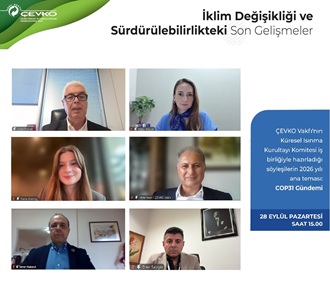
In the online interview organized by ÇEVKO Foundation, the critical threshold of the climate crisis and sustainability practices were discussed. The common point of the speeches, from scientists to young climate ambassadors, was clear: "The forms of expression must transform as much as the systems."
The online interviews organized by ÇEVKO Foundation, which brings together the identities of an expert industrial initiative and an active non-governmental organization, in cooperation with the Global Warming Congress Committee, continue in their 5th year. The first interview of 2025 was held under the title "Latest Developments in Climate Change and Sustainability" and the dangerous dimensions of global warming at the current point were discussed.
The speakers of the conversation, moderated by Global Warming Congress Committee Member and Economy Writer Çetin Ünsalan, were ÇEVKO Foundation Secretary General Mete İmer, ETİ Gıda Environmental Engineer Ensar Sakarya, Istanbul Gelişim University Faculty of Economics, Administrative and Social Sciences Deputy Dean, RTS Department Lecturer. Member Dr. Özlem Tuğçe Keleş and Bahçeşehir University Climate Ambassador Kamil Koray Eryılmaz became the new climate ambassadors. The main axis of the conversation was based on communication methods as well as environmental data.
Giving the opening speech of the interview, ÇEVKO Foundation Secretary General Mete İmer stated that the world average temperature increase has reached 1.5 ° C by 2024 and said, "The climate crisis is the biggest problem facing humanity. In the Paris Climate Agreement, the goal of not exceeding the 1.5 ° C temperature increase is emphasized. According to the World Meteorological Organization 2024 data, the increase in the world average temperature reached 1.5 ° C. However, it reached this threshold in a one-year period." "This does not mean that the entire process has been lost and the situation has become irreversible, so there is still hope. We can overcome the problem by increasing social awareness and using our science, mind and conscience. We will hear from our speakers both the communication and awareness perspective and the good examples of responsible industrial practices. What gives us hope and morale is the awareness and initiative of young people on this issue." he said.
Stating that there is a lack of communication regarding climate change throughout the world, Istanbul Gelişim University Faculty Member Dr. Özlem Tuğçe Keleş said, "We more or less know the effects of climate change on our lives, we are aware of it. However, it is explained to us with such distant expressions, distant definitions, and distant discourses that it is positioned as something whose consequences will not directly affect us. However, this is a subject intertwined with human history. When you look at the hieroglyphs in Egypt, you see how people were affected by the floods, how they tried to escape and survive, and how they depict their struggle against the land. Or if you want to understand why the Mayan civilization migrated, the relationship with water "You look at the relationship. All migration stories are written about losing water. Climate change has caused us to migrate or increase social vulnerabilities throughout history, as it does today." He said.
Dr. draws attention to the importance of communication and news language, title and word choices in studies on climate and environmental problems. Özlem Tuğçe Keleş continued her words as follows: "Of course, environmental scientists, physicists and climate experts do important work, but as long as we cannot establish a connection between numbers and society, we lose sensitivity. Climate change is directly related to the tree in front of our house, the water flowing from the tap, and the food we put in our pot. Even though the news on this subject causes us to worry, we forget after seeing it because life has to go on again the next day. That is why, when establishing the communication framework, we tell people by giving them a sense of responsibility and empathy instead of fear." We need to establish a language that can say 'you too have a share, you can have a role in the solution', like the European Union or Yale University. In countries like Turkey, where fragile groups are concentrated and where there is a risk of climate migration, communication strategies are useless. For example, when we say "there is no loss of life", we ignore nature, trees and soil. However, we always put the responsibility on others. "In fact, 1 minute of artificial intelligence usage can be equal to a month's electricity consumption of a house. But we do not talk about this. The language of news, the language of movies, and the language of social media must change. A more authentic, empathetic, human-touching climate communication is necessary, but we are still walking in our own shoes."
ETİ Gıda Environmental Engineer Ensar Sakarya, who took the floor in the industrial aspect of the interview, shared that they measured the company's carbon footprint in three contexts. He also gave information about the use of renewable energy within ETİ Gıda and the 8.6 MW rooftop solar power plant. Explaining that ETİ Gıda has implemented various practices not only in production but also in the field of waste management and circular economy, Sakarya said: "Sustainability is not a certificate issue, it is a matter of culture, we are trying to create a model in which blue-collar personnel are involved in the process as well as the Board of Directors." he said. "At ETİ, we address sustainability under the headings of Environment, People, Value Chain, Innovative Transformation, in the context of happiness for our planet, people, our business and our future, based on our traditional brand slogan." he said. In his speech, which started by giving information about consumer and technology trends as well as information about ETİ Gıda, Ensar Sakarya also touched upon the issue of sustainability and its dimensions, and how sustainability is handled within ETİ. Ensar Sakarya also gave information on the topics of life and employee happiness at ETİ, and career and internship opportunities at ETİ.
Bahçeşehir University Climate Ambassador Kamil Koray Eryılmaz stated that the youth is not only "a group that is concerned about the climate" but also an actor who produces solutions. Eryılmaz, who also attended the COP Summit held in Azerbaijan, emphasized that youth participation is not symbolic but constructive and said, “Young people want to produce work in the field, not at the desk. That's why it's not enough for brands to just talk; they also need to contact us after the event and include us in the processes.” he said.
Youth, industry, academia and civil society meet with different languages but a common concern; ÇEVKO Foundation's "Latest Developments in Climate Change and Sustainability" interview, which once again demonstrated that not only technical information sharing but also transformation in the form of expression is necessary in the fight against the climate crisis, was noted as one of the important steps taken for effective climate communication.
You can also watch the conversation titled "Latest Developments in Climate Change and Sustainability", prepared by the ÇEVKO Foundation in cooperation with the Global Warming Congress Committee, on the ÇEVKO Foundation's YouTube channel:


Information Notice and Personal Data Protection Policy under the Personal Data Protection Law: The personal data listed by way of example in Article 2 of the Personal Data Protection Policy may be shared with the ÇEVKO Foundation and used on its website, applications, and social media channels, to be used in notifications and recommendations, and to be shared with third parties for commercial purposes provided that it is in the interest of the members, and I hereby accept and declare my explicit consent, defined under the KVKK as “consent based on information and freely given for a specific purpose.”
You can manage cookie categories separately
For more information, you can check the Privacy Policy and Protection of Personal Data pages